
ISO 9001:2026 Publication Date Confirmed: What Organisations Need to Know
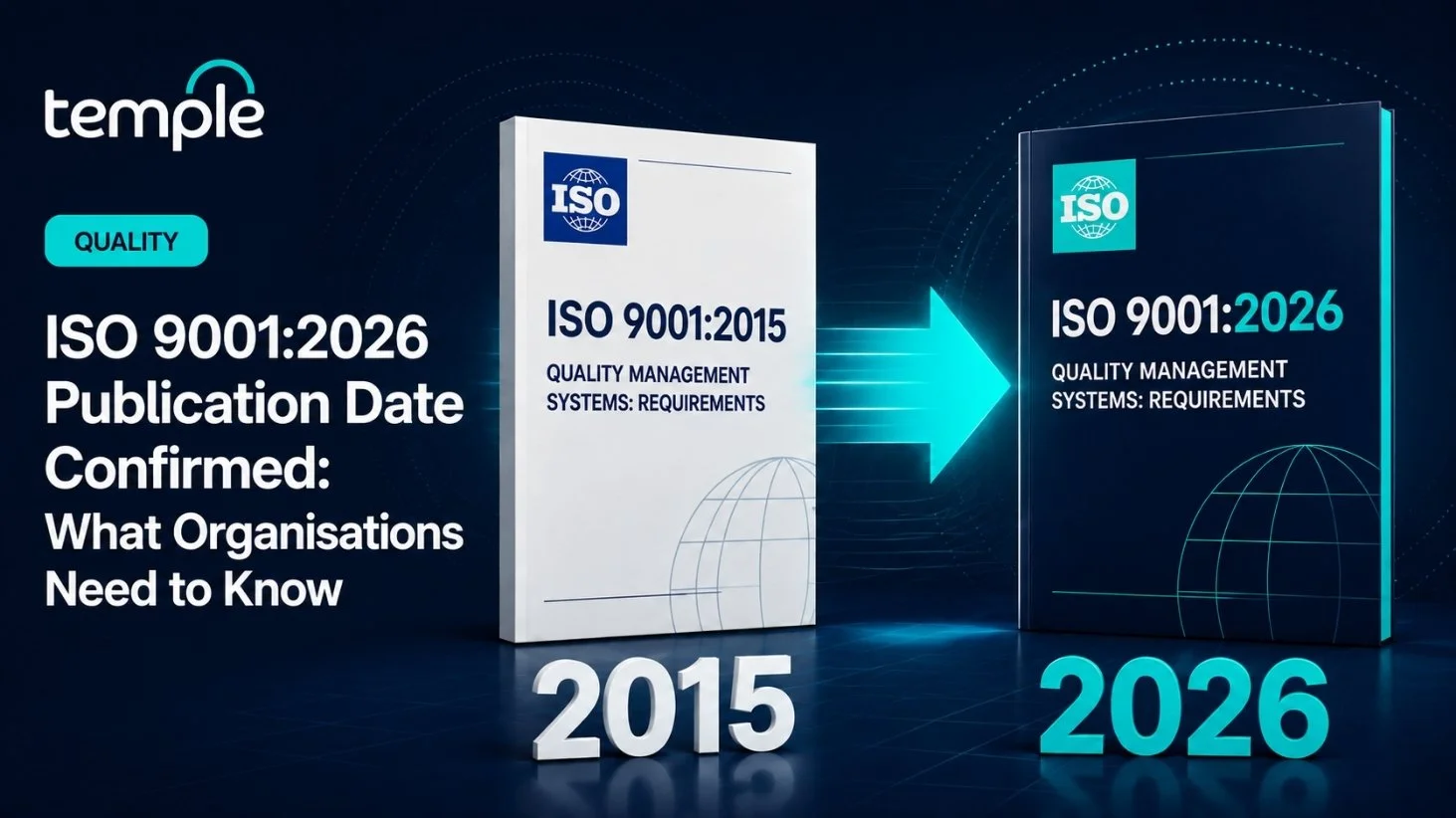
ISO 9001:2026 is due to be published on 16 September 2026, giving organisations certified to ISO 9001:2015 a much clearer timeline for preparing for the revised quality management standard.
The revision has now reached the publication stage following the Final Draft International Standard (FDIS) process. ISO currently lists the sixth edition of ISO 9001 as “under publication”, with publication scheduled for September 2026.
For organisations operating an ISO 9001:2015 quality management system, this is an important milestone.
It does not mean that existing certification suddenly becomes invalid in September. Instead, publication of the new edition will begin the process of moving certified organisations from ISO 9001:2015 to ISO 9001:2026.
The priority now is to understand what is changing, assess how those changes affect your existing QMS and prepare in a controlled way.
The next edition of ISO 9001 is approaching.
Publication will mark the beginning of the next stage for organisations currently certified to ISO 9001:2015.
Where does the ISO 9001 revision stand now?
The revision of ISO 9001 has been underway following the decision in 2023 to update the standard.
In May 2026, ISO confirmed that ISO/FDIS 9001 had been released for ballot. That ballot subsequently closed in July, and ISO's official project record now places the standard at stage 60.00 – International Standard under publication.
This means organisations no longer need to treat the revision as a distant possibility.
The new edition is approaching, and QMS managers, internal auditors and leadership teams should now be considering how they will manage the transition.
Is ISO 9001 being completely rewritten?
No.
ISO describes ISO 9001:2026 as a set of targeted updates designed to improve the clarity, usability and continued relevance of the world's most widely used quality management system standard.
The familiar foundations of ISO 9001 remain important. Organisations should therefore be thinking in terms of evolution rather than starting their QMS again from scratch.
ISO's published information about the 2026 edition highlights:
clearer wording and requirements;
a stronger focus on leadership, accountability and quality culture;
greater clarity around risks and opportunities;
a new Annex A intended to clarify terminology and the intent of requirements; and
closer alignment with other ISO management system standards.
For organisations with an effective ISO 9001:2015 system, much of the existing management system should continue to provide a strong foundation.
The task will be identifying where the revised requirements create genuine gaps.
What is changing?
The framework remains familiar, but several areas receive greater clarity and emphasis.
Quality culture
Greater attention to the environment and behaviours that support quality throughout the organisation.
Leadership & accountability
A stronger focus on leadership involvement and accountability for quality management.
Risks & opportunities
Greater clarity around the way organisations consider and address risks and opportunities.
Annex A
New informative guidance to clarify key terminology and the intent behind requirements.
System alignment
Closer alignment with other ISO management system standards.
A stronger focus on quality culture
One of the notable themes highlighted by ISO is the stronger focus on leadership, quality culture and accountability.
An effective quality management system depends on more than documented procedures.
It is influenced by the decisions leaders make, the behaviours they encourage and the extent to which people understand how their work contributes to quality and customer outcomes.
For organisations preparing for ISO 9001:2026, useful questions include:
Do leaders visibly support the objectives of the QMS?
Do people understand how their work contributes to quality?
Are quality considerations part of normal business decision-making?
Is the desired quality culture reflected in everyday behaviour?
Does leadership involvement extend beyond management review meetings?
This is one reason transition should not be viewed solely as a project for the quality department.
Risks and opportunities receive greater clarity
Risk-based thinking is already an established part of ISO 9001:2015.
The 2026 edition brings greater clarity to the management of risks and opportunities, making this an important area for organisations to review.
Risks and opportunities are related, but they should not simply be treated as interchangeable terms.
A risk could involve circumstances that adversely affect an intended result. An opportunity could provide the potential to improve performance, capability, customer outcomes or the effectiveness of the QMS.
Risk and opportunity are not the same thing.
What could affect an intended result?
- Operational disruption
- Loss of organisational knowledge
- Supplier performance
- Process variation
- Changing customer requirements
Where could performance improve?
- Improved technology
- Knowledge sharing
- Process optimisation
- New organisational capability
- Better customer insight
Leadership and accountability
The increased emphasis on leadership reinforces an important principle: an effective QMS cannot operate independently of the way an organisation is managed.
Top management should therefore understand the forthcoming changes rather than leaving transition planning solely to the quality team.
That does not necessarily mean creating more meetings, procedures or paperwork.
It means ensuring that quality is integrated into the organisation's direction, priorities and decision-making, and that leadership can demonstrate meaningful involvement in the effectiveness of the QMS.
Annex A and interpretation
ISO has also highlighted a new Annex A designed to provide greater clarity around key terms and the intent of requirements.
Annex A is informative. It should help users understand and apply ISO 9001 more consistently rather than creating an additional layer of requirements.
That distinction matters.
Organisations should avoid turning useful explanatory material into unnecessary QMS bureaucracy.
What happens to ISO 9001:2015 certification?
Publication of ISO 9001:2026 does not mean existing ISO 9001:2015 certificates suddenly become invalid.
ISO has confirmed that organisations certified to ISO 9001:2015 will be given a transition period in which to migrate their quality management systems to the new edition.
At the time of writing, the detailed international transition arrangements and final deadline have not been formally published.
A three-year period may be anticipated based on previous ISO 9001 transition arrangements, but organisations should not treat September 2029 as a confirmed deadline until the formal arrangements are announced.
Publication is the starting point — not an overnight switch.
Existing certification will move through a formal transition process.
ISO 9001:2015
Current certified management systems continue to operate.
New edition
ISO 9001:2026 is scheduled for publication.
Prepare & migrate
Understand, assess, update and transition the QMS.
To be confirmed
Formal transition arrangements are still to be announced.
What should organisations do now?
There is no reason to panic about ISO 9001:2026.
There is equally little benefit in ignoring the revision until the transition window is beginning to close.
Organisations can start preparing now without prematurely rewriting their management systems.
The most useful first step is understanding.
Seven things organisations can do now
Understand the revision
Build awareness of the direction of ISO 9001:2026 and what it could mean for your QMS.
Brief leadership
Make sure senior management understands why the revision matters and where leadership involvement will be important.
Review the existing QMS
A well-maintained ISO 9001:2015 management system provides the strongest foundation for transition.
Review risks and opportunities
Consider whether your current approach addresses both in a meaningful and useful way.
Assess competence
Identify who will require awareness, transition or auditor development.
Plan your gap analysis
Compare the new requirements systematically with the existing QMS and identify genuine gaps.
Make proportionate changes
Change processes where there is a reason to do so — not simply because the edition number has changed.
Don't begin by rewriting everything
One of the easiest mistakes during an ISO transition is to assume that every procedure, process and form needs to be rewritten.
It does not.
For an organisation with an effective ISO 9001:2015 management system, much of the existing QMS should continue to provide a strong foundation.
A better approach is to understand the revised requirements first, compare them with the existing system, identify genuine gaps and then make proportionate changes.
What should internal auditors be doing?
Internal auditors will have an important role during the transition to ISO 9001:2026.
They will need to understand more than where wording has changed.
An effective auditor needs to understand what a requirement is trying to achieve, how it applies within the context of the organisation and what objective evidence demonstrates that the management system is working.
As organisations prepare, they should consider whether their internal audit programme and auditor competence remain appropriate.
Is your audit team ready for ISO 9001:2026?
The transition isn't only about changing documentation. Auditor competence matters too.
Can your auditors evaluate leadership without simply following a checklist?
Can they distinguish genuine quality culture from policy statements?
Can they evaluate risks and opportunities in organisational context?
Do they understand what has actually changed in ISO 9001?
Can they verify whether transition actions are effective?
What does ISO 9001:2026 mean for organisations already certified?
For a mature organisation, transition should be an opportunity to review and improve the management system rather than simply change references from “2015” to “2026”.
It is worth asking whether the existing QMS genuinely supports the organisation.
Does it help management make decisions?
Does it identify meaningful risks and opportunities?
Do people understand their contribution to quality?
Does internal audit identify weaknesses and opportunities for improvement?
Is leadership genuinely engaged with quality performance?
And does the management system help the organisation consistently meet customer requirements?
Those questions matter regardless of the edition number printed on a certificate.
ISO 9001:2026 training with Temple QMS
As publication approaches, quality professionals, internal auditors and managers will need to understand how the revised requirements affect their responsibilities.
Temple QMS provides practical, expert-led ISO 9001 training covering different stages of the quality management learning journey — from foundation knowledge and internal auditing through to Lead Auditor development and blended learning pathways.
Build your ISO 9001 capability.
Choose the learning pathway that matches your role, experience and professional goals.
Foundation
Build your understanding of ISO 9001.
Internal Auditor
Learn to audit your organisation effectively.
Lead Auditor
Develop advanced professional auditing skills.
Blended Learning
Combine flexible e-learning with tutor-led training.
16 September 2026: the next chapter for ISO 9001
The publication of ISO 9001:2026 will mark an important point for organisations around the world using the standard.
But transition should not be treated as a race.
The organisations best positioned for the new edition will be those that understand the changes early, involve the right people, identify genuine gaps and make proportionate improvements.
The aim should not simply be to obtain a certificate showing a new edition.
It should be to ensure the quality management system continues to support customers, organisational performance and continual improvement.
Start preparing with confidence.
Develop the knowledge and auditing skills your organisation needs to understand, maintain and improve an effective quality management system.